This article was originally written in Chinese and translated into English by AI.
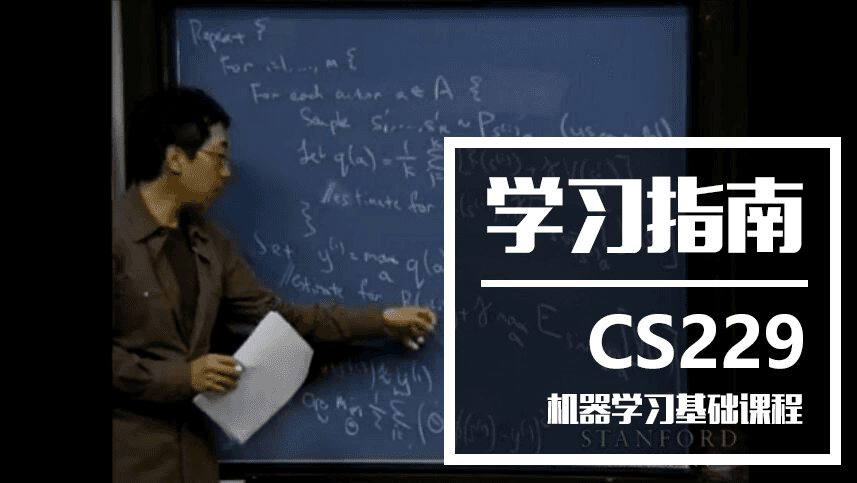
This guide provides a course introduction, a collection of learning resources, and study advice for CS229. Beginners are strongly encouraged to read it before starting the course.
1. Course Introduction
- Course: CS229
- Instructors: Andrew Ng and Ron Dror
- Subject: machine learning, with an emphasis on mathematical principles
- Prerequisites: probability, calculus, linear algebra, and sufficient English proficiency
- Difficulty: challenging; not recommended for beginners
- Topics: linear models, naive Bayes, SVMs, learning theory, PCA, factor analysis, ICA, and MDPs for reinforcement learning
- Characteristics: emphasizes mathematical principles rather than programming implementations
- Intended audience: graduate students in mathematics and computer science
2. Learning Resources
- Videos: Bilibili (includes Chinese subtitles, but the translation quality is very poor) | YouTube
- Course materials: lecture notes, assignments, and other materials
3. Study Advice
3.1 The Barrier to Entry
CS229 is Stanford’s introductory machine-learning course and provides the foundation for CS231N in computer vision and CS224N in natural-language processing.
However, I strongly advise beginners not to take it! I strongly advise beginners not to take it! I strongly advise beginners not to take it!
The course contains a great deal of mathematics and does not emphasize programming implementations.
If you are merely interested in machine learning, want to understand and apply algorithms quickly, and do not plan to conduct related research, try Andrew Ng’s Machine Learning and Deep Learning courses instead.
CS229 is suitable for graduate students in mathematics or computer science, as well as undergraduates in their third year or later.
In my experience, anyone without enormous interest in machine learning and a great deal of perseverance can easily give up halfway through. Again, consider Machine Learning and Deep Learning instead.
To be clear, I do not recommend the course to beginners because of its high mathematical barrier and the advanced material covered later on. Its explanations of individual algorithms are nevertheless very thorough. Lectures six through eight are the best introduction to SVMs that I have encountered.
3.2 Course Content
CS229 is one of Stanford’s classic courses. Among the resources linked here, the videos were recorded in 2008—the only available video version—while the lecture notes and assignments are from 2017.
Do not worry that the videos and notes will disagree, or that the videos are outdated. The CS229 syllabus today is almost identical to the 2008 version. The largest difference is the addition of two lectures on neural-network fundamentals, but that is not important because other courses provide a more comprehensive treatment of neural networks.
The course covers linear models, naive Bayes, SVMs, learning theory, PCA, factor analysis, ICA, MDPs for reinforcement learning, and more.
Compared with the widely read Chinese textbooks Statistical Learning Methods and Machine Learning, also known as the “Watermelon Book,” it does not cover two fundamental subjects: decision trees and ensemble learning. You can study Statistical Learning Methods alongside CS229.
3.3 Other Advice
The quality of the Chinese translation of CS229 is poor. Readers with sufficient English proficiency should watch the original English version or rely only on the English subtitles.
I also recommend studying the lecture notes alongside the videos. After watching a lecture, read the corresponding notes to review it. I printed all of the notes to make annotation and later review easier.
I have completed the entire course. If you have questions about its content, feel free to leave a message on the WeChat public account “技术杂学铺” for discussion.