
This article was originally written in Chinese and translated into English by AI.
I used AI to help build a website that tracks my workday—and my time spent slacking off. This article records what I learned along the way.
I had not felt very motivated at work lately, so I suddenly decided to build a website that would push me to stay productive while also telling me how long remained until I could go home. That idea became this website:
https://goldflow.mwhitelab.com
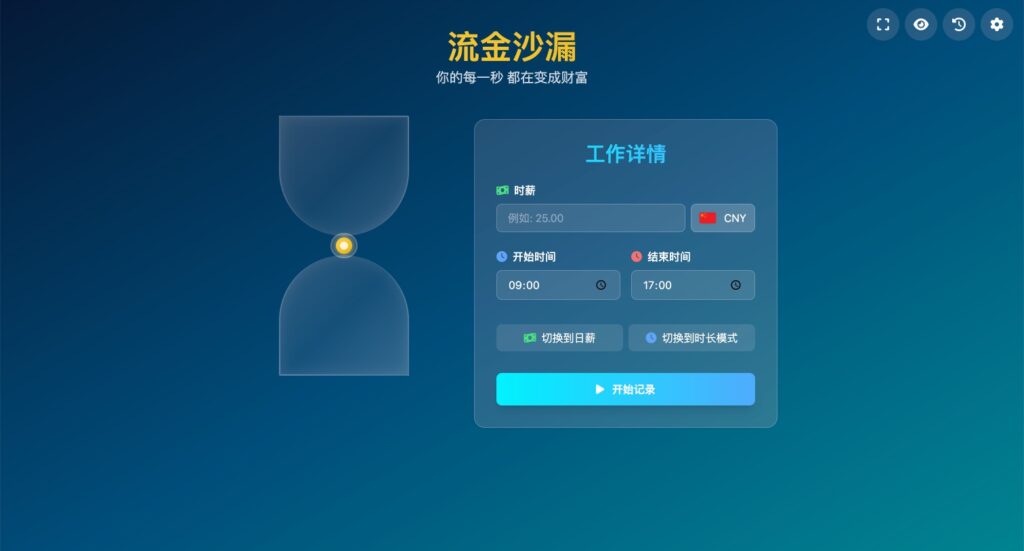
The project’s Chinese name is Goldflow Hourglass. The original idea was an hourglass whose sand flows as time passes; when all the sand has fallen, the workday is over. The sand’s golden color also represents money gradually flowing into your pocket over time.
The website lets users choose the visual theme, salary currency, and language. It currently supports Simplified Chinese and English.
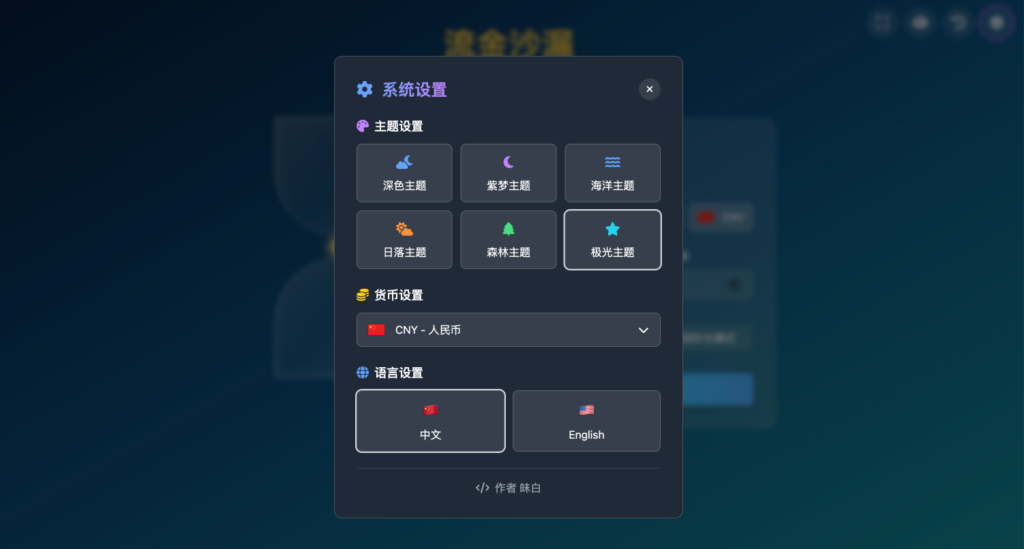
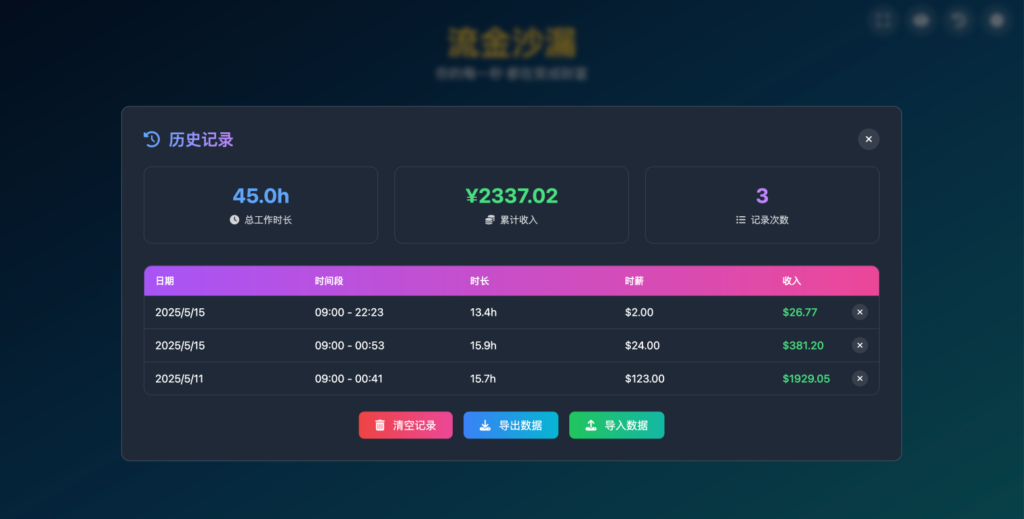
Users can also view, import, and export historical data.
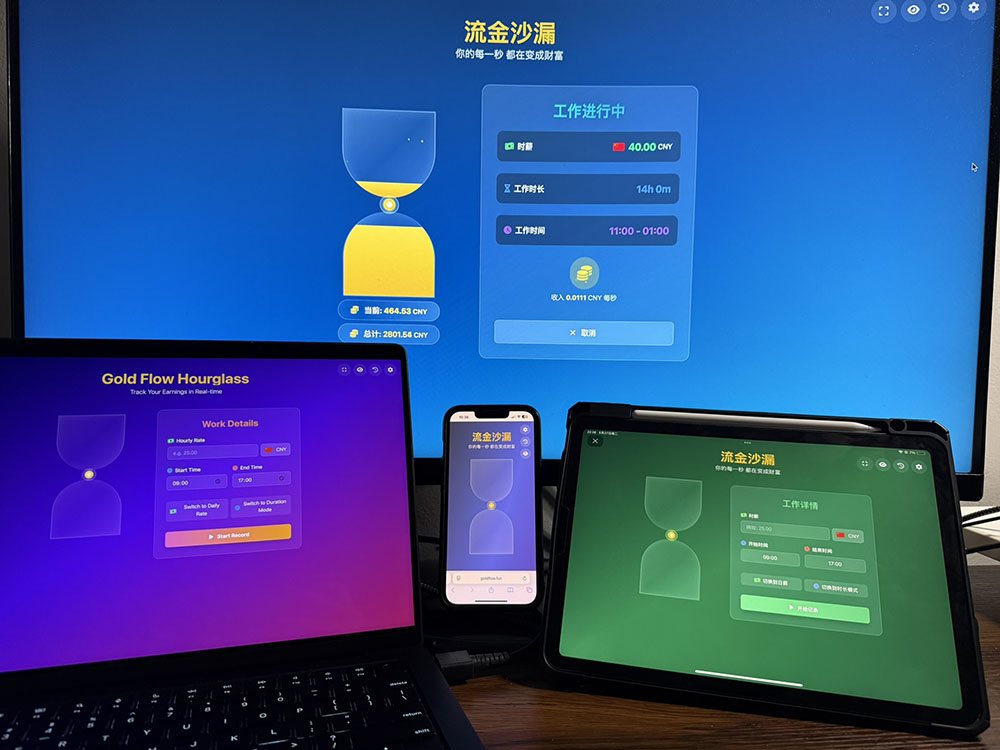
The site uses a responsive layout and works on phones, tablets, and computers.
The entire project is a purely front-end website. All data is stored locally on the user’s device, so it is safe to use.
The project itself is not complicated—perhaps around the level of a university course project—and its practical value is modest. A friend once complained that they could not even tell what the website was for. I built it partly because the idea amused me and partly because I wanted to learn a modern front-end technology stack.
I completed the entire project with help from Cursor. Cursor can be understood as a code editor with built-in AI features. You can select sections of code or particular files and describe what you want in plain language. Cursor then calls large language models such as ChatGPT or Claude to read and modify the code and briefly explain its changes.
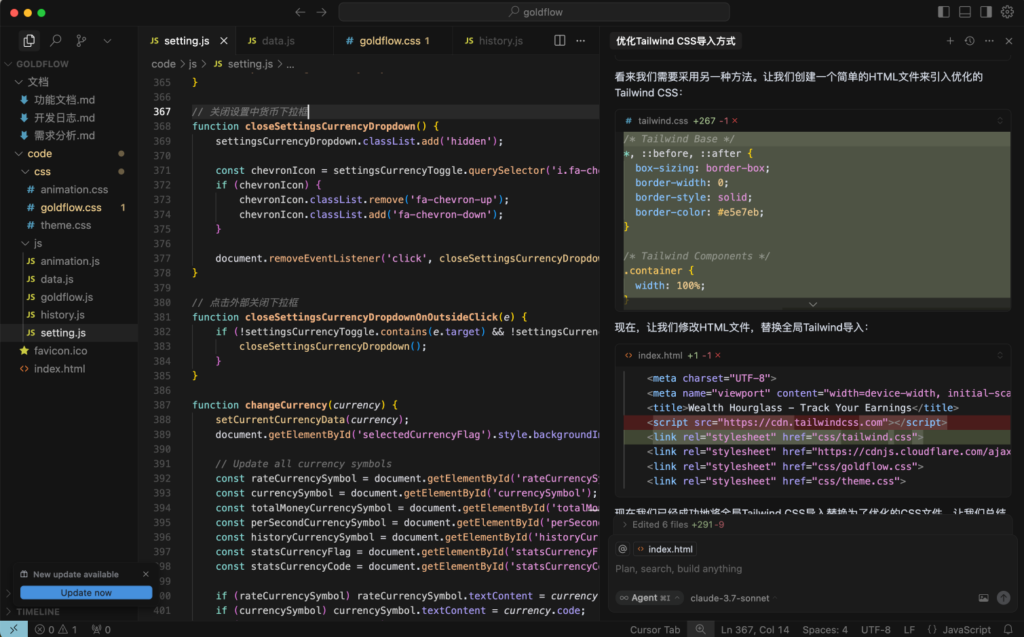
The Cursor interface, with the code editor on the left and the AI chat panel on the right
With Cursor’s help, I did not need to understand much of the technology stack. I only had to describe my requirements clearly and let AI complete them step by step. AI became the programmer, while I only needed to act as the product manager.
What I Learned from AI-Assisted Programming
After using Cursor to build the website for a while, my attitude began to change.
Before using AI-assisted programming, I considered myself a perfectionist. I wanted elegant code, clear logic, and the lowest possible algorithmic complexity. Sometimes I spent a great deal of time optimizing a function simply because the resulting code looked “better.”
But after becoming the “product manager” who directed Cursor to write the website, the codebase grew quickly, and I was unfamiliar with much of it because I had not written it myself. Understanding the implementation would have required significant time and effort. At that point, I stopped focusing on the code’s internal logic and started caring mainly about whether it met the requirements and worked.
Cursor also writes code far faster than a human. My perfectionism began to resemble the literary character Kong Yiji obsessing over the four ways to write a single Chinese character. Early on, I tried to read every line generated by AI, understand it, and improve its logic. Gradually, I became satisfied with understanding the broad idea as long as it worked. Of course, this was a personal hobby project. Production code at work should still receive human review line by line.
Cursor has certainly lowered the barrier to programming, but that does not mean coding knowledge has become useless. In my experience, Cursor sometimes proposes poor solutions: it may overcomplicate a task, generate unrelated code, or create unnecessary duplication. Diagnosing the cause, improving the prompt, and asking it to try again still requires a foundation in programming.
Overall, however, even someone without a coding background can now build simple software with AI assistance.
I once thought programming was a profession that demanded intense intellectual labor. Now it seems more like an ordinary job performed by replaceable workers.
My experience with Cursor made me realize that AI is lowering technical barriers for programmers, product managers, and other knowledge workers alike.
Some Further Thoughts
The remainder of this article contains some informal thoughts about AI. They are speculative and may be wrong.
Sometimes when we complain that AI is useless, the real problem may be how we are using it.
For simple factual questions—such as naming the planets in the Solar System or identifying the country where Sydney is located—a large language model can answer directly with high accuracy. For problems that require reasoning, such as calculus, a direct answer may be unreliable. That is why models such as ChatGPT o1 and DeepSeek R1 use reasoning chains to work through a problem in multiple steps.
We should not conclude that AI cannot solve calculus simply because its first direct answer is wrong. AI can solve complex mathematical problems; we may just be using the wrong method. Accuracy on mathematical tasks improved significantly after chain-of-thought approaches were introduced.
Likewise, today’s common approach to AI programming is to describe a requirement in a paragraph, let AI read the entire codebase, and ask it to make the change. This may work for a small project, but it becomes inefficient for a large one. In my experience with Cursor, the codebase grows increasingly messy as the amount of code increases. That does not necessarily mean AI cannot handle large projects. It may simply mean we have not yet found the right way to use it.
Perhaps future coding-focused AI models will use specialized algorithms that account for requirement documents and reason about how to divide code logically across multiple files.
I think the future AI market may resemble today’s global automobile or laptop industries. A modern laptop is the result of collaboration among many companies:
– The brand may be Xiaomi, Huawei, or Lenovo, but those companies may not design the core CPU chip themselves, with Apple being a notable exception.
– The CPU may be designed by Intel, AMD, or Qualcomm, while manufacturing depends on other companies.
– Samsung or TSMC may manufacture the CPU, while the lithography machines required for chip production come from the Dutch company ASML.
No single company can independently design, produce, and manufacture every component in a laptop.
I believe the future AI market will develop a similar model of collaboration.
AI-related companies can currently be divided into two groups, although more categories may emerge as the market develops and functions become more specialized.
The first group develops large language model algorithms. Companies such as OpenAI, DeepSeek, and Alibaba’s Qwen are responsible for researching and developing large language models. They invest enormous resources and computing power in training language, image-generation, and video-generation models. These models have huge parameter counts and require specialized equipment and AI knowledge, making them unsuitable for most users to operate directly.
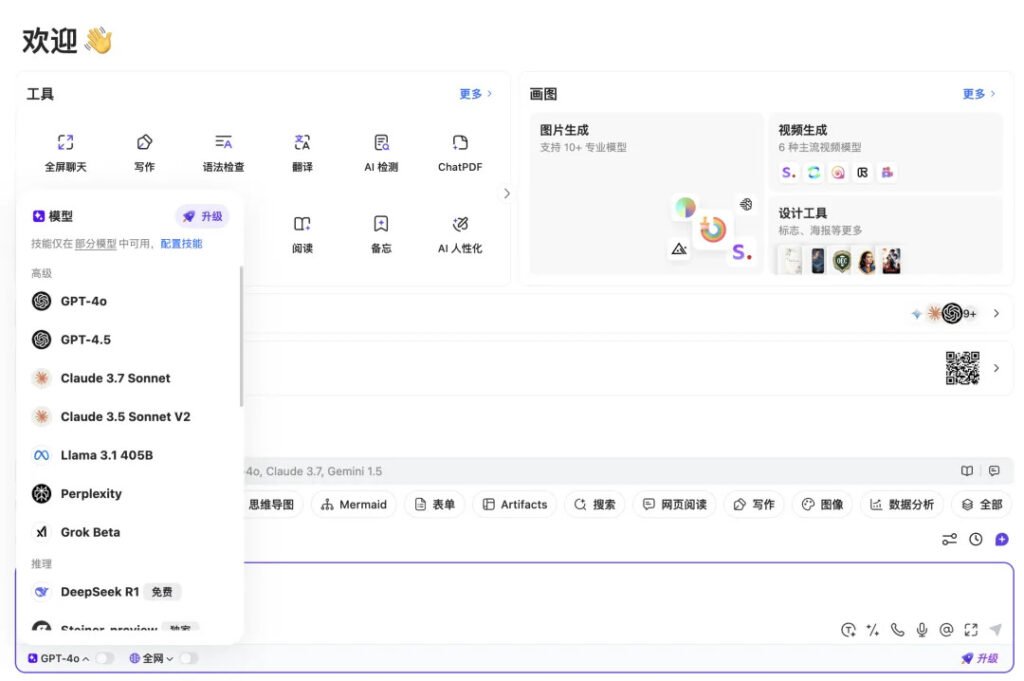
The second group focuses on applications and deployment. These companies call models created by the first group and concentrate on applying those models. Examples include AI features inside Cursor, AI customer service, and smartphone assistants. These companies build interfaces for user interaction, manage conversation history, and store personal information for customized responses, thereby building a bridge between ordinary users and large language models.
Programmers looking for work in the AI industry have two broad options. The first is to pursue a master’s degree or doctorate in artificial intelligence and then seek a research role at a company in the first group. Such positions are limited and have demanding academic requirements.
The second is to join a company in the application layer and build products closer to users. These roles still require some AI knowledge, but less than core model research. Alternatively, a programmer can become an independent developer and create AI-related tools.
An old joke claims that mathematics is useless because nobody buying groceries asks for “sin²x plus cos²x kilograms of vegetables.”
But mathematics is useful. Linear algebra, for example, forms part of the mathematical foundation of computer graphics, mechanical engineering, finance, and artificial intelligence. Video games, the design and manufacture of heavy machinery, personal financial planning, and financial market analysis all depend on it. Linear algebra is already present throughout daily life; we simply do not notice it.
The same can be said of AI. We may not perceive an obvious change in our lives, but AI technology is quietly contributing to human technological progress.
Today’s AI still has many shortcomings, but we should approach them like researchers: when a new technology is imperfect, we should ask how to improve it rather than dismissing it from a position of superiority and abandoning further investigation.
I remember that when video style transfer and text-to-image generation first became widespread several years ago, the internet was full of contempt. Many comments complained that AI-generated content looked fake and that style-transferred videos—for example, converting live-action footage into animation—flickered badly.
If we had focused only on those limitations and stopped investing in the technology, AI would have stopped developing. A research mindset instead asks why the video flickers, whether temporal information has been handled properly, and how the method can be improved. Modern video style-transfer and generation models, such as Google Veo 3, can now produce continuous, highly realistic video.
Goldflow Hourglass source code:
https://github.com/DrMofu/goldflow
Postscript: I genuinely admire people who run side projects outside their day jobs. My regular job does not require overtime, yet I still have no energy to code after work. I started this project in early April and procrastinated on it intermittently until the end of May, when it finally became this prototype and article.