This article was originally written in Chinese and translated into English by AI.
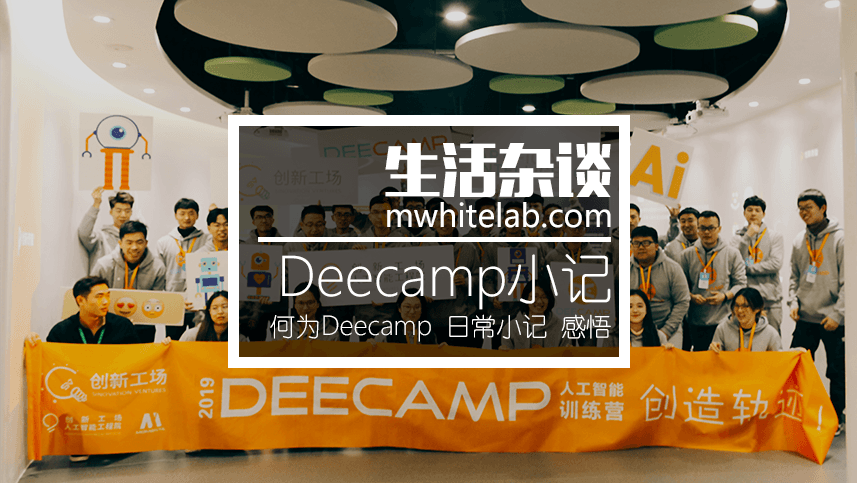
From January 20 to 28, 2019, I attended the Nanjing session of the Deecamp winter program organized by Sinovation Ventures. These are some of my experiences and reflections.
What Is Deecamp?
Deecamp is an AI training program organized by Sinovation Ventures. The winter camp invites leading figures from academia and industry to introduce real-world applications in light of cutting-edge AI developments and helps students independently complete their own AI projects. Its goal is to cultivate the next generation of AI talent.

This winter’s week-long Deecamp enrolled more than thirty participants at each of its Beijing and Nanjing locations. Beijing projects included robotic-arm vision applications, a remote-control protocol for autonomous vehicles, and a low-latency video-return system. Nanjing projects covered reinforcement learning, adversarial attack and defense, quantitative finance, and autonomous driving.

I joined the adversarial attack-and-defense project in Nanjing. The following sections recount a few interesting moments from the winter camp in chronological order.
A Brief Diary
January 20 – Registration
When I entered Sinovation Ventures’ Nanjing institute, I felt as if I had arrived in the future.

Artificial intelligence was already being used in practical applications here. Winter-camp participants could enter the offices simply by scanning their faces, while the lobby contained vending machines that accepted facial-recognition payments.
These examples of futuristic technology and Sinovation Ventures’ attractive office environment left a deep impression on me.

Next came registration and introductions among the participants. Talking with other members left me amazed by their accomplishments. Most were graduate students from leading Chinese universities such as Peking University, Tsinghua University, Fudan University, and Shanghai Jiao Tong University. Studying abroad, entering AI competitions, participating in AI projects, and interning at major companies seemed like routine experiences for them.
Over the following days, their ambition beyond technical work and their attitude toward setbacks further demonstrated their excellence.
January 21 – Knowledge Sharing
January 21 was devoted entirely to knowledge-sharing sessions, with slightly different courses in Beijing and Nanjing.
In the morning, after a brief opening ceremony, participants at both locations attended a course on commercializing artificial intelligence taught by Yonggang Wang, executive director of the Sinovation Ventures AI Institute.

In the afternoon, Ji Feng, head of the Nanjing AI Institute, taught the fundamentals of adversarial learning and computational finance.
Once participants had defined the specific content of their projects, the week-long practical Deecamp project officially began.
January 21–27 – Project Work
My broader group worked on “adversarial attack and defense.” More specifically, another participant and I tackled adversarial attack and defense through black-box attacks.
Cloud providers such as Tencent Cloud and Baidu Cloud now offer intelligent image-recognition services. We can use these services without knowing how their AI works. Our goal was to find a way to “deceive” an image-recognition service into incorrectly identifying image A as image B.

In other words, we wanted to try different methods to make Tencent Cloud’s image-recognition service fail—in a legal research setting.
The purpose was not malicious destruction, but to investigate the weaknesses of neural networks so that better defenses could be developed.
“Black box” means that we did not know how Tencent Cloud’s AI image-recognition service was implemented or what neural-network architecture and parameters it used. We could only upload images, observe the returned classifications and probabilities, and use that information to try to defeat the service.

Neither my teammate nor I had relevant project experience in adversarial attack and defense. We started everything from scratch.
After seven days of project work, I felt rather tired. Our schedule could be described as “997”: working from 9:00 a.m. to 9:00 p.m., seven days a week.

Throughout the project, we often made no progress despite a great deal of reading and coding. During the first few days in particular, I frequently worried that our project might not achieve the expected result.
Although the process was full of difficulties, we ultimately persevered and learned a great deal. I will share my personal reflections later rather than repeat them all here.
The project period also included many interesting sessions, such as Yonggang Wang’s discussion of implementing AI projects, Yang Yu’s overview of reinforcement learning, and Momenta’s presentation on autonomous driving.
January 28 – Project Presentations
The final day was devoted to project presentations. After seven days of hard work, every participant had finally reached the moment of harvest.


I will omit the details of our project results. In short, we achieved a good outcome and won the Best Demo Award.

P.S. Members of the best team could advance directly to the final interview stage at Sinovation Ventures, AInnovation, and Momenta—an extremely attractive opportunity.
Conclusion
Deecamp’s summer and winter programs were inspired by Foo Camp, where participants design the schedule, topics, and content themselves.
Teachers at Deecamp therefore do not lead students by the hand through every task, and there are certainly no dubious courses promising “deep learning in seven days.”
Participants choose a general subject, define their own specific research question, and complete the project step by step. Teachers act only as guides, pointing students in a broad direction and offering appropriate help when they do not know how to proceed.
Deecamp is therefore less a place to study than a place to build projects. Participants encounter practical subjects such as quantitative finance and autonomous-vehicle control that combine academic research with real-world applications.
You could say that academia and industry both blossom here.

Finally, I would like to thank Sinovation Ventures for providing this learning opportunity; Ji Feng, head of its Nanjing AI Institute, for taking valuable time to guide our project; and every teammate who worked alongside us.

Miscellaneous Notes
- My teammate and I arrived at 8:30 every morning and did not leave until after 9:00 at night—yet somehow we were among the earliest to leave! Another group departed at 10:00 every night and was the second-earliest!
- Momenta’s presentation taught me for the first time just how much knowledge autonomous driving involves. It also left me with the impression that Momenta was a highly promising and energetic autonomous-driving company.
- To finish their project, the neighboring team stayed up working at Sinovation Ventures all night. They were still there when we arrived the next morning. Their dedication was incredible...
At the very, very end, here is an inside joke that only the Nanjing Deecamp participants will understand.
